Showing posts with label DIY. Show all posts

Saturday, 21 March 2020

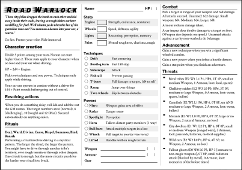
One page game: Road Warlock

A free one-page game created to answer the question "what if the vehicles in a post-apocalyptic road warrior movie were demons that crave speed and violence?"

Partly inspired by Neil Gaiman and Terry Pratchett's book Good Omens, in which the demon Crowley arranges the layout of a motorway overpass to create a bad-vibes-generating satanic glyph when people drive over it.

I may have missed an opportunity by not adding drop bears to the bestiary. Maybe in future editions. Click here to get it.


And since it's an excellent time to be gaming by yourself at home, here's a link to my diceless solo gaming engine.

Saturday, 15 February 2020

One page game: Agents of P.U.N.C.H.

A free one-page game about playing elite government agents who are completely out of their depth.

I've made no secret of my admiration for Tales of Mordhearse, an ultra-light D&D adaptation where the characters have only one stat: HP. The game makes that single stat do a lot of work. It's surprisingly deep and tactical, not to mention perfectly suited for dungeon exploration.

I was thinking about that design philosophy, a single stat game. And I was in a whimsical mood. I wondered "what if the single stat all the characters had in common was punching? And what if that stat was universally set to maximum?"

The result is Agents of P.U.N.C.H. It's not deep. It's not tactical. I'm not sure what kind of game it's suited for, other than (obviously) a very silly one. But it's free! Click here to get it.


Saturday, 8 February 2020

Silence of the dice

A diceless GM emulator for solo or no-prep gaming.

I read Silence of the Lambs at an impressionable age. I find Hannibal Lector fascinating. Not as a killer, but for his disciplined mind. There's a scene in the book where the FBI need information from him, so they strap him into a straightjacket and bite mask and simply wait... believing he'll tell them what they want to know rather than endure the discomfort indefinitely. Instead, he waits them out and uses the time to think about a favourite piece of music.

Whenever I read about a technique or rule for solo role-playing I ask myself, could Hannibal Lector use this as a distraction during his interrogation? Could I use it while waiting in line to renew my driver's license? (I have a terrible habit of letting my phone battery run down completely before I think about charging it.) What's the minimum amount of equipment you need to run an RPG, anyway? We can eliminate dice. Can we eliminate char sheets, note paper and pencils too?

The first thing you need is a randomiser and for the games I want to play, numbers are still the best. Just thinking of a number won't work. Even if you can be objective and not pick a number that favours your character, figures from your own mind will never be random. I like mathematician George Marsaglia's. It's pseudorandom rather than truly random, but the pattern is complex enough that you'd need to be a savant to predict it without a tool like a spreadsheet. The method goes like this:
  1. Think of a 2-digit 'seed' number.
  2. Multiply the second digit by 6 and add it to the first number.
  3. Use the right-most digit of the new number as your random number.
  4. Keep going from the previous 2-digit number as long as you need new random numbers.

Example:
  1. Our seed number is 23.
  2. The new number is 2 added to the result of 6 x 3.
  3. The result is 20. Our random number is the right-most digit, 0. (I'd take this as 10.)

Our next random number would be 2 + (6 x 0) = 2. From there: 2, 3, 9, 6, 9, 5, etc. If I wanted this to be a d20, I'd add 10 if the first digit is odd. The 2-digit number's range is 1 - 59, so the first digit makes a pretty good d6.

D12: Use the first digit, add 6 if the second is odd.
D4: Get a D12 result, divide by 4 and use the remainder.
D8: Use the process for a D4, then generate another random number. If it's odd, add 4 to your D4 result. The extra steps for these two are both annoying enough that I probably won't use them.

Note: I originally posted that you can get a D8 result by dividing a D12 result by 8 and using the remainder - which is obviously wrong, because 12 is not divisible by 8.

None of these results are truly representative of a fair die, but they're fair enough for my purposes. (Would this work at a table? Only if you had uniquely patient players.)

You also need a way to figure out what happens. I've had good results using the Mythic GM emulator, but it's too involved to keep it all in my head. Instead, I assign a number out of ten for the likelihood of something happening - 7/10 for likely, 3/10 for unlikely, 5/10 if I really don't know. If I roll equal or below the number, it's a positive result. If I roll a 1 or a 10, it's a critical result, which translates to some kind of extreme version of the expected outcome.

The way the randomiser's maths works out, there's a 1/8 chance of the two digits being a double - 11, 22, 33, etc. If I get a double, the unexpected happens.

I also need to determine what happens. For that I'm using a simple system of elemental associations -


Rolling a d12 on this table will give me an action, a faction or a personal quality. It's up to me to interpret what that means for my game. I think it's a good rule of thumb to relate it back to a detail already in the game. If I know a specific faction is involved, I can interpret an answer to mean that particular faction is taking action or displaying a quality.

So far so simple. I can remember these things without consulting a rulebook. But if I want to go completely diceless, I need to pick the right game as well. Dice pool systems are out. In Shadowrun, our tank routinely rolls three dozen dice to soak damage. Exalted pools can get even larger. Even percentile or 2d6 systems are going to be annoying, so I'm probably looking at something D&D-ish. 

I've had good results testing with a modified version of Here Is Some Fucking D&D by redditor dm_magic.  (Clean version available here.) I discard AC scores and add the opponents movement rate to an attack roll, with a target of 20. I also drop the damage roll and have weapons do full damage on a it.

Long term, I might opt for something even simpler, like Tales of Mordhearse by unwashedmendicant. Characters get one stat and a few simple qualities.

Saturday, 19 October 2019

Goblin variants

Image from Wikimedia.org
I'm slowly and painfully thinking through a dungeon populated by goblins. In order to keep it interesting and justify what I hope are some genuinely underhanded tactics, I'd like to introduce a bit of variety into the inhabitants.

Ranked in order of toughness:

Goblin runt

The smallest and scrawniest of the goblins, they've had to be quick and smart to survive among their bigger kin.

AC 6, HD 1-2 (2hp), Att 1 × weapon (1d6 or by weapon), THAC0 19, MV 80’ (40’), SV D14 W15 P16 B17 S18 (NH), ML 7 (9 with king), AL Chaotic, XP 5, NA 2d4 (6d10), TT R (C)

Snot flick - a goblin with hayfever is never unarmed. Instead of attacking, a runt can flick a blob of mucus with pinpoint accuracy to a range of 10'. No damage, -2 to next attack roll.

Goblin bootlicker

These disgustingly obsequious toadies hang around with goblin pit bosses and champions, yelling warnings and throwing them extra ammo when called for.

AC 6, HD 1-2 (2hp), Att 1 × weapon (1d6 or by weapon), THAC0 19, MV 60’ (20’), SV D14 W15 P16 B17 S18 (NH), ML 7 (9 with king), AL Chaotic, XP 5, NA 2d4 (6d10), TT R (C)

Has a satchel containing (1d6):
  1. dried rat meat. (1 ration)
  2. goblin brew. Tastes like a bugbear's loincloth. Burns with a blue flame. Might sterilise a wound then infect it with something different.
  3. part of a halfling.
  4. 1d4 tallow candles.
  5. 1d2 doses of berserker mead.
  6. 2d6 teeth.

Goblin bomber

Easily recognised by the cooking pots they wear as helmets and the slow-matches they tuck under the brim, even goblin bullies leave these guys alone. Bombers are runts who've taken an interest in chemistry. Madder than a soup-fork and half as useful, they make bombs by packing black powder into pottery, wooden tubs, skulls, anything they can find.

AC 5, HD 1-2 (2hp), Att 1 × weapon (1d6 or by weapon), THAC0 19, MV 60’ (20’), SV D14 W15 P16 B17 S18 (NH), ML 7 (9 with king), AL Chaotic, XP 5, NA 2d4 (6d10), TT R (C)

Fire in the hole - a bomber carries 1d4 black powder grenades. Every second round they can throw one with a 15' range. On detonation, 1d6 damage to the square it lands in and 1d4 to adjacent squares. on 1-in-6 the bomb explodes while the goblin is still holding it.

Goblin shaman

Shamans typically know a few low-level spells and prepare the beserker mead that drives a few goblin warriors into a killing rage.

AC 7, HD 1-1 (3hp), Att 1 × weapon (1d6 or by weapon), THAC0 19, MV 40’ (15’), SV D14 W15 P16 B17 S18 (NH), ML 7 (9 with king), AL Chaotic, XP 5, NA 2d4 (6d10), TT R (C)

Spells known (one of): Remove Fear, Cure Light Wounds, Darkness.

1d3 pots of berserker mead: +2 Att and damage, +2 AC. Save vs poison to stop fighting.

Goblin regular

A bog-standard goblin as described in the monster manual.

AC 6, HD 1-1 (3hp), Att 1 × weapon (1d6 or by weapon), THAC0 19, MV 60’ (20’), SV D14 W15 P16 B17 S18 (NH), ML 7 (9 with king), AL Chaotic, XP 5, NA 2d4 (6d10), TT R (C)

Goblin bully

Bigger than an ordinary goblin, and meaner too. Everything they have, they've taken from someone smaller.

AC 6, HD 1 (4hp), Att 1 × weapon (1d6 or by weapon), THAC0 19, MV 60’ (20’), SV D14 W15 P16 B17 S18 (NH), ML 7 (9 with king), AL Chaotic, XP 5, NA 2d4 (6d10), TT R (C)

Gimme dat - if disarmed or jealous, a bully can take a weapon from a goblin in an adjacent square as a free action.

Goblin berserker

Frothing at the mouth, biting their own ears and attacking with no regard for an enemy's relative strength.

AC 8, HD 1 (4hp), Att 1 × weapon (+2, 1d6+2 or by weapon+2), THAC0 19, MV 60’ (20’), SV D14 W15 P16 B17 S18 (NH), ML 7 (9 with king), AL Chaotic, XP 5, NA 2d4 (6d10), TT R (C)

Goblin pit boss

Pit bosses have years of experience at not dying to adventurers. With a pit boss bellowing orders and enforcing them with kicks and punches, goblins will function like (semi-) disciplined fighters.

AC 5, HD 1+1 (5hp), Att 1 × weapon (1d6 or by weapon), THAC0 19, MV 60’ (20’), SV D14 W15 P16 B17 S18 (NH), ML 7 (9 with king), AL Chaotic, XP 10, NA 2d4 (6d10), TT R (C)

Tactics - if a pit boss has bombers, bullies will form up in front of them as a protective line while they throw bombs. If the pit boss has runts, they'll flank adventurers while the bigger goblins keep them tied up in melee. Pit bosses count as kings for morale checks.

Goblin champion

Champions have been round the block a few times, and collected a couple of souvenirs on the way. Each champion will have a minor magic item (1d6):
  1. Wand of Cold, 1d6 charges.
  2. +1 sword.
  3. Ring of Control Animals.
  4. Potion of ESP.
  5. Potion of Heroism.
  6. Wand of Fear.
AC 4, HD 1+2 (6hp), Att 1 × weapon (1d6 or by weapon), THAC0 19, MV 60’ (20’), SV D14 W15 P16 B17 S18 (NH), ML 7 (9 with king), AL Chaotic, XP 10, NA 2d4 (6d10), TT R (C)

Tactics - as pit boss.

Champions count as kings for morale checks.

Goblin hound

Inbred, abused and semi-feral mongrels who've had to fight for every scrap of food. On 1-in-6, they attempt to eat the closest runt instead of attacking the adventurers.

AC 7, HD 2+2 (11hp), Att 1 × bite (1d6), THAC0 17, MV 180’ (60’), SV D12 W13 P14 B15 S16 (F1), ML 6 (8 in larger packs), AL Neutral, XP 25, NA 2d6 (3d6), TT None

Boom - sometimes bombers like to strap canisters full of powder and nails with a short fuse to hounds.

Saturday, 5 October 2019

One page game: Wizard Squad

Image by OpenClipart-Vectors from Pixabay
A free one-page game about tactically-trained wizards empowered by the state to investigate incidents of corrupted ancient magic reactivating. Semi-random character creation, 1d20 + mods vs target number. Grab it here.

Wizard Squad is set in a kingdom which is built on the ruins of an advanced civilisation that drove itself into apocalypse through excessive magic-use. Every now and then the seals and wards on some forgotten device breaks down (as often as not through tampering by someone who thinks there's something to be gained by reviving ancient sorcery) and then it's balrogs or worse.

Saturday, 21 September 2019

World turtle immobilised part 2

Further exploration of the thought experiment in which we have a world carried on the back of a turtle crash into a spherical one.  This time, the landscape underneath the turtle.

In this post I talked about a full-sized globe planet which has had a second planet, a flat one carried on the back of a juvenile world-turtle, land on its surface with minimal damage.  (IE. we still have two worlds, but they're not in great shape.)  Generations have passed, civilisation has more or less recovered from the turmoil and they're in a position to start looking around and wondering what actually happened.

What's known is that the weather is wetter, there are vast salt marshes forming to the East where the a new geographical feature blots out the sun for half the morning, and strange new animals have been seen in those regions.  And the sages, who have read the antique writings, say the winters are now milder, the summers are hotter and the year is two days shorter than it used to be.  Gods were probably involved, but there's no consensus on who they were punishing or for what.

Expeditions sent by the new empire to explore the area don't actually see the turtle with any kind of clarity.  It's too vast.  On a clear day, from a hundred miles away, you might see a hint of a head or a flipper, with a titanic disc above.  The water pouring off the disc falls into vacuum, which instantly converts it to a fog.  It drifts down, where the jet stream helps by pushing it away to the West.  There's still enough water in the air around the turtle to surround it with clouds.  They figure out it's turtle-shaped by mapping it.  On horseback by land, and by ship where its hindquarters overlap the ocean.  In the process they discover The Bite and the curious effect the blood which is still oozing from it has had on the local wildlife, but that's for a later post.

(I did a back-of-the-envelope calculation of how much water is pouring off the disc if it has the same flow rate as Niagara Falls.  Then I decided that that magic which recycles that water back onto the disc is still working — otherwise it would have doubled the amount of water on the planet's surface in the first five minutes.)

What the explorers actually see is cloud-covered lands with a strange top-heavy mountain at the centre.  It's never truly dark here  There's a bright point in the fog, lighting it from the inside.  Sometimes it's above the mountain, far away and dim, sometimes it's close and the cloud glows with a diffuse light.  (One explorer described it as 'akin to being shrunk down and standing at the centre of a cold candle flame'.)

The turtle is ringed with concentric circles of volcanic chasms because it's slowly crushing the continental plate under it (its magical nature gives it some buoyancy even in death, otherwise there'd be no slowly about it). If you remember the first post, the turtle world is the size of Ceres, which is shown on the left here compared to Earth. Its weight has created a depression around it which has filled with brine, making an inland sea a few dozen miles wide.

The area around the turtle was damaged so badly in the cataclysm that none of its life survived. The landscape is slowly being recolonised by hardy plants and a few animals that would be equally at home in a desert. The only intelligent life is a few small, migratory clans of orcs and gnolls.

Saturday, 14 September 2019

One page game: Green Card Demons

A free one page game about demons trying to make it in today's economy, integrate socially and also cover it up when they slip and commit horrible crimes.  Semi-random character creation, 2d6+mods vs target number. Get it here.

Thanks to Reddit users Don_Quesote and HeadWright for commentary and layout advice and ThornyJohn for sourcing open license fonts.

I love one page games.  They're perfect for those evenings when your regular GM can't be there or there aren't enough players to make a serious attempt at carrying on the adventure.

Saturday, 10 August 2019

Base building mini-game

I've been playing a lot of Subnautica lately.  It's an open-world exploration game, set 90% underwater.  It has beautifully rendered environments and creatures that really sell it as a completely alien planet.

A big part of the fun is the base building mini-game.  You start basic and level it up as you uncover new blueprints.  My preferred method of gathering resources has become moving to a new area and building a small base with a scanner room that can pinpoint all the useful spawns for me.  When you disassemble a base you get 100% of the materials back, so the only investment is time.

(Meeple Girl has been playing a very different game.  It involves waiting until I'm under threat by a Warper or a Sea Dragon, then walking quietly up behind and tapping me on the shoulder... it ought to be a crime.)

The last couple of weeks I've been thinking about a method for adding a base-building mini-game to OSR games.  Admittedly, some of them already have it, in the form of castles and strongholds from 9th level onwards.  But that's intended to be a significant investment of time and resources for the characters, and a reward for the players who levelled their characters that far, as well as a completely new mode of play.  I'm going for something a lot simpler and self-contained, that the players can get into almost immediately.  This is what I've come up with.  I think it would work best in a system where XP is earned by spending treasure.

It's assumed that the characters will be taking over the available space across several buildings instead of renting a house or workyard.  They'll modify it to suit their needs, as much as practical given the restrictions.  The spaces they have access to are represented by the seven unique Tetris blocks:


Each square in a piece is 10' by 10'.  The first costs 100 GP, or whatever amount is suitable for your system.  Each additional segment doubles the cost.  The characters can keep building until they have everything they need or run out of money.  Each time the players ask for a segment, roll 1d10 and give them the piece indicated.  If the result is higher than 7, repeat the last block.

After the first piece is placed, roll 1d4 for each additional piece to see which cardinal direction from the original piece the next is added to.  The players can rotate the pieces as they like.

The edges at the outside of the pieces (not the individual squares) are assumed to be walls.  The spaces the players put together have no access to each other until they start knocking out walls.  The edges for each piece must be more than half wall to support its weight.  That's five edges for the O piece, six for the others.  Take out any additional walls and the roof falls in.

Example

My budget for rooms is 1,000gp.

First room = 4, the O piece.  100gp.


Second room = 1, the I piece.  The d4 shows a 1, indicating that it's placed at the top of the O piece.  200 gp.

Third room = 4, the O piece again.  The d4 shows a 2, indicating that it's placed at the right of the first O piece.  400gp.


Fourth room = 2, the J piece.  The d4 shows a 3, indicating that it's placed below the original O piece.  800gp, so no more rooms.


If I remove the walls between the two O-pieces, I get a nice big, open space.  Each O-piece can have one additional wall removed, which gives access to the smaller rooms, like this:


Within the limits above, pieces are placed and rotated at the players' discretion.  So if I preferred I could have had a base like this:


And that second layout looks more useful because of the next rule: courtyards.  You can extend the outermost walls in a straight line.  Where they intersect, they enclose a courtyard.  That long, semi-wide layout gives us a couple of decent courtyards for extra space.


For upper levels, start the pricing again from base.  Use the same layout but with each new floor remove 1d2 of the outermost rooms.  There must be at least one staircase on each floor.


What's the point of all this?  The base is mostly intended to be a fun way for characters to spend more gold, and something for the players to feel invested in.  If you're using the XP-for-spending-gold rule, you're probably also using a carousing table.  The rooms you add to your base will give some minor bonuses for mitigating bad rolls on that.  A forge can knock out the dings in armour, an apothecary can shorten the duration of a hangover, etc and you can hire retainers with the skills to use them on a temporary basis.

So next we slot in rooms.

Apothecary - 1 square.  Gives access to a herbalist.  +1 to saves vs disease, allergies, hangovers, etc.

Armoury - 1 square.  Sharpens blades, repairs weapon handles and straps.

Barracks - requires 1 square for each character that sleeps there.  Restricted to one open edge.  Reduces gold lost during a bad carouse by half because you were sensible and left your big purse at home.

Common room - at least 2 squares.  +1 to retainer morale rolls while in town.

Forge - at least 3 squares.  Must be in a courtyard.  At least 1 empty square between it and the nearest building.  Gives access to a smith, who can repair armour.

Kennel - 1 square per 4 dogs.  Must be in a courtyard.  Gives access to a master of hounds, who can provide training and treat sick dogs.

Kitchen - 2 squares.  Rations prepared here will never be tainted or inedible except by deliberate enemy action.  Requires a well.

Library - at least 1 square.  Gives a bonus to research actions and somewhere for magic-users to work.

Shrine - at least 1 square.  A place for rituals.  Gives clerics and paladins a bonus to communing with their gods.

Stable - 1 square per horse.  Each square must have one open edge facing a courtyard or the outside of the building.  Gives access to an ostler, who can replace shoes and treat sick horses.

Staircase - 1 square.  Gives access to other levels of the building.

Training room - at least 3 squares by 2.  Gives access to a trainer if required for levelling or learning new techniques, subject to GM approval.

Trophy room - 1 square per 4 trophies.  The perfect space for displaying souvenirs of past adventures and impressing young wenches or farmboys.

Wash house - 1 square.  removes fleas, tar and feathers, various other forms of soiling.  Requires a well.

Well - 1 square.  Must be in a courtyard.  At least 1 empty square from a forge.

In this case I'm going to have a training room, an apothecary, an armoury, a wash house, a kitchen, a trophy room, a forge, a well, a kennel for 8 dogs and a stable for 4 horses.  My characters can sleep off site.  Opening up all the stable squares to the courtyard means blocking the stables off from the building interior, but that's not a problem.  If you're riding a horse, you're going outside anyway.

Key:
A - stables
B - forge
C - trophy
D - apothecary
E - armoury
F - training
G - kitchen
H - wash house
I - well
J - kennels


And now the part I'm sure my players will spend the most time over: traps.  200 GP each.

Arrow trap

Collapsing ceiling

Fire trap

Gas trap

Glue trap

Magic item trap

Pit trap (if on an upper floor, requires 1 square of unused space on the floor below it)

Poisoned dart trap

Potion trap

Swinging blade trap

There's no reason to restrict player creativity here.  If they want a false wall that releases angry bees, they can have it.  Any 5' square (4 per map square) can be trapped.  The players can set or deactivate a trap as an automatic action, unless you're a particularly hard-nosed GM.  If characters let a retainer get caught in a trap, make a morale roll at a penalty.

Hey, isn't this starting to look kind of like a dungeon?

Yes!  And for your players, this might be an opportunity for introspection that leads to a revelation about their behaviour and real change on a personal level.  Mine are more likely to say "Hey, why not a trap that douses intruders with shrinking potion then drops them into a trebuchet?"

Saturday, 3 August 2019

World turtle immobilised

Picture a world-carrying turtle. Four elephants on its shell, and a flat planet on their backs.  We want the turtle to be visible from the edge of the world, so have the turtle's length overlap the planet's by about an eighth at front and back.  That should give us a bit of flipper and a head to look at if we're peering down from the very edge, where the ocean turns into a waterfall that tumbles endlessly into space.  For the planet to have the same surface area as the Earth, that would make it about 19,000 Km or very roughly 12,000 miles across.  Big.

We want it to be smaller, because we're about to crash it into an inhabited world.  Let's make it a baby, only about the size of Japan.  That gives us 1,200 Km (750 Mi) of turtle, and makes the world on its back 900 Km (560 Mi) across.  Still big.  If we take a Loggerhead turtle as our template, it's a turtle the size of Ceres, the largest asteroid ever discovered.  It's not a dinosaur killer, it's more like the school bully that beats up dinosaur killers and steals their lunch money.  So instead it makes a semi-controlled landing and immediately dies because something much larger than it is has taken a bite out of its side.

(Sages of the day recorded that something whale-shaped blotted out constellations over several nights, other mystics point out that it had a triangular fin on its back.  Educated men know the world is round and can use parallax measurements to estimate the creature's size, but they quickly run out of beads on their abacus in the attempt.)

Even a controlled landing by a 1,200 Km turtle is going to mess up your planet.  First there's the noise, the loudest ever heard.  Birds are knocked out of the air by the pressure of the sound wave.  Then there's the hurricane of displaced air, tearing up forests and stripping fields.  The impact (no more than a kiss, really) sends millions of tons of soil and rocks billowing into the atmosphere, blotting out the sun.  All across your continent, dormant volcanoes erupt back into life, spewing magma and toxic gas.  Earthquakes shiver your cities apart.  The first of the great forests far enough from the crash site to have survived begins to burn.  Rocks the size of houses crash down, entire countries distant.

A third of your population dies in the first few hours.  Half that number again starve as crops fail and the landscape plunges into a winter that will last three years.  More are killed by bandits and wandering companies of looting deserters during the civil war that follows, or forced to flee into the wastes as refugees.  It takes a while for civilisation to re-emerge, establish a government and rule of law, and solve enough of its ongoing problems to think about sending an expedition to the site of the impact to see what the hell happened.  Two generations doesn't seem like an unreasonable length of time.

In the meantime, strange rumours have been filtering out of the East (which is arbitrarily where our turtle landed in relation to the new centres of government).  Never-ending salty rain.  An inland sea where none existed before.  Oddly symmetrical mountains on the horizons.  A shining globe above those mountains, half-hidden by a haze of distance.  Enormous, glowing spheres crashing across the landscape.  Strange, savage animals and plants.

It would be a whole new world, within reach of the recovering old world.  I think I could make a campaign out of that.

Saturday, 27 July 2019

City plague tables

It's the winter months here, and with winter comes cold and flu season.  I've been sick lately, and staying at home.  To keep the time from being a total loss, I thought maybe I could use the illness as a source of inspiration.

This is a series of event and encounter tables for districts of a fantasy city struck by a plague.

Escalation stages


  1. Rumours and mutterings.  Ominous omens.  Prophets offering warnings in the market square.
  2. Official denials from the government.
  3. Theatres and public events closed.  Dusk-to-dawn curfew announced.  Extra guards recruited.
  4. The wealthy and well-connected begin sending their families out of town.  Government announces that foreigners or minorities may be carrying a sickness.
  5. Martial law.  Markets closed.  24-hour curfew announced.  Travel between districts is suspended.  Gates to the richest and poorest districts are shut and guarded.  Carts travel the streets collecting the dead.
  6. Foreigners and minorities are attacked on site by hysterical mobs.  Fires are spreading.  Gangs operate unopposed in all but the richest districts.  The dead lie in the streets.
  7. The mobs have run themselves to exhaustion.  The city is silent as people wait out the crisis in their homes.
  8. The contagion has burned itself out.  People begin to emerge from their isolation and start putting the city back in order.

Docks

The docks is a place where people are constantly coming and going as ships dock and depart.  There are crowds of day labourers waiting for work carrying goods.  The businesses here are ship outfitters, warehouses and pubs.

Event table:

  1. A boat captain and his crew are facing off against a merchant and his men.  The captain is refusing a shipment of pork because it may be infected, the merchant is insisting that he pay for it even if he leaves it on the dock.  Neither side is backing down.
  2. A gang of looters armed with clubs is emptying a warehouse while the owner stands helplessly watching, yelling for the city guard or anyone to stop these thieves.
  3. A ship is dumping cargo on the docks to make room for passengers who are offering everything they have for transport away from the city.  A group of ragged locals is snatching up all the goods they can carry, and squabbling over the best loot.
  4. City guards are 'taxing' anyone who wants to enter or leave the docks.  Several ship crews have gathered in a group to try and push through without paying.  The guards have called for reinforcements.
  5. A group of three boats is refusing to dock.  The harbour master is threatening to destroy them with fire arrows if they leave without unloading their cargo.
  6. A fight in a dockside pub is spilling out into the road, blocking several streets.

Encounter table:

  1. A rich man with his family, his retainers and all his household goods, looking for a boat to hire.
  2. 1d4 'sailors' approaching individuals and small groups, promising passage on a boat they have tied up with its lights doused at the end of an unlit jetty.
  3. 1d6 stevedores without work, looking for other ways to make some money.  They'll attempt robbery if the odds look good.
  4. 2d4 city guards looking for a chance to use their new authority.
  5. 2d4 smugglers trying to buy or steal valuable cargoes cheaply.
  6. 2d6 angry and aimless sailors whose ship has left without them.

Market square

This is a wide cobbled square near the centre of the city, where the main roads intersect.  There are stalls selling everything from ironmongery to livestock.  Rumours spread quickly and everyone's already on edge, but people still need to buy food and other necessities.

Event table:

  1. Someone with an obvious plague-rash collapses, groaning loudly.  People nearby scream and run, fearing infection.
  2. A zealot is haranguing the crowd from a platform, telling them the plague is a judgement for their sins.  Some of the crowd are shouting at him to shut up and go away, others are nodding along and yelling encouragement.  There's potential for a riot.
  3. A group of stallkeepers are packing up, planning to leave the city.  A group of bullies is telling them to leave their goods if they're going to run like cowards.  So far it's a stand-off.
  4. A shout carries through the crowd "It's them!  They brought the plague here!" A group of hysterical townfolk are preparing to stone two foreigners.
  5. A delegation of citizens are marching to the government square gates to demand that the city council take action on the plague.  They're followed by a large group of jumpy hangers-on.  City guards are massing at the gate to stop them entering.
  6. Squads of guards begin moving through the crowd, arresting anyone who looks foreign, poor or a troublemaker.

Encounter table:

  1. A hawker selling miracle cures.  1-in-6 chance they're actual medicine.  2-in-6 chance it's a purgative.
  2. Town crier reading out a list of emergency measures the mayor has decreed.  The crowd's mood turns darker.
  3. A madman, yelling that the gods will be satisfied and lift the plague if a wicked few will repent and mend their ways.
  4. 1d4 town guards using their new authority to extort and pilfer from passersby.
  5. 1d6 cultists preparing a ritual to appease the gods and bullying passersby into joining them.
  6. 2d4 angry drunks looking for someone to blame for the plague.

Slums

The poorest of the citizens live here.  Guards never travel these streets.  Order is enforced by gangs.  Crime is everywhere.

Event table:

  1. Families are barricading the entrance to this street and threatening anyone who approaches the barrier.
  2. A gang are taking over a building, boarding up the ground floor entrances and shooting from windows at people who approach.
  3. A mob have set fire to a building with several infected people inside.  They have the building surrounded and are throwing stones to keep anyone from escaping.  The fire threatens to spread to nearby buildings.
  4. A family of labourers are preparing to publicly hang their landlord.  Passersby seem uninterested in helping him.
  5. A man with one eye and a scarred face is handing out stolen liquor to anyone who wants it, making him the hero of the moment.
  6. People are killing cats, dogs and rats and throwing their bodies into a bonfire as a preventative measure.

Encounter table:

  1. A dead plague victim, lying in the street where they died.
  2. A crippled beggar, shouting that the gods will spare those who show charity.
  3. 2d4 gang members with rags tied around their faces and hands, extorting money from the healthy and clubbing the infected to death.
  4. A hysterical mob of 2d10 + 10 stoning anyone who doesn't look like a slum-dweller.
  5. An elderly couple who have been pushed into the street to fend for themselves.
  6. 2d6 patrolling vigilantes, interrogating passersby about their business here.

Craft district

The city's middle class.  These streets are made of workshops and courtyards with homes above the shops.  The wealthy are often seen here as customers.

Event table:

  1. Several fine riding horses are loose and milling around uncertainly.  They're on edge and ready to spook.
  2. Hot metal in an abandoned forge has started a fire in the courtyard.  It's spreading.
  3. A group of craftsmen are burning down their guildhall.
  4. A group of craftsmen with their families and carts piled high with their belongings are forming a caravan to leave for another city.
  5. Workshops all along this street are closing their gates and putting up their shutters.  Several are already abandoned.
  6. A craftsman has fired his apprentices.  They have him cornered against a wall, angrily demanding back wages.

Encounter table:

  1. Two masons armed with sledgehammers are grimly fighting two city guards with swords.
  2. A woman supports a heavily-bleeding man while two young children cry and pull at her skirt.
  3. A recently-killed man lies in the bed of a horseless cart.  Around him are cases and chests which have been broken open and tossed aside, empty.
  4. 1d4 + 1 apprentices have broken into a cask of wine they were delivering and are laughing and staggering in the street.
  5. 1d6 + 2 assorted craftsmen armed with workshop tools are facing off against a gang of 2d4 thieves.
  6. A patrol of 2d6 city guards are walking the street, ordering anyone who looks out of place to leave the district.

Wealthy district

Big and luxurious homes with neat gardens and high walls to ensure their privacy.  The residents can afford their own security and city guards are only tolerated here.  The streets are watched and someone will take note of anyone who doesn't look like they belong.

Event table:

  1. A burgher is directing his personal guard to prepare a gallows for a servant he suspects of stealing.  They're setting it up in the courtyard of his house.  Several of the city guard are watching but making no attempt to intervene.
  2. A group of citizens have gathered outside an unpopular rich man's house, demanding that he come out and face them.  His only reply is to pour water on them from an upstairs window.  The crowd's mood is getting uglier.
  3. A party is going on behind a high wall set with spikes along the top.  There's harp music, laughter and the sound of clinking glasses.  The gate has had a carriage overturned behind it to block it completely.
  4. A maidservant is banging on a door pleading to be allowed back in.  She shouts that she's not infected because she hasn't been among strangers, but the door stays firmly shut.
  5. A crowd of craftsmen, labourers and delivery carters is being pushed out of the district by a laughing mercenary squad, who are telling them they're not wanted here until the plague has run its course.
  6. A richly-dressed man is setting his dogs on a shabbily-dressed one, shouting that he'll make an example of any thief he finds.

Encounter table:

  1. A luxurious carriage with an armed driver and two crossbowmen on the roof.  Heavy brocade curtains hide the passengers.
  2. 1d4 thieves dressed as and pretending to be servants.  They're keen to know the characters' business in case it points them towards a rich target.
  3. 2d4 mounted lordlings, the sons of the ultra-rich.  They're armed and arrogant, playing at defending their district from looters and rioters.
  4. 2d6 mercenaries patrolling the street.  They order anyone who isn't dressed expensively or as a servant to leave the district.
  5. 2d6 city guards patrolling.  If any local citizens are watching, they attempt a show of hustling the characters away from the district.
  6. 3d6 assorted citizens in various states of drunkenness, certain the rich are hoarding a cure for the plague, intending to take it for themselves and their families.

Saturday, 20 July 2019

Gonzo mansion

Image by David Mark, downloaded from Pixabay
I like the gonzo element of a lot of OSR material.  Of course there's a logical reason the wizard built a maze out of live eels inside a colossal gem suspended within a dead god's eye socket.  But you're under no obligation to explain it to the players -- or even decide what it is in the first place.

And by the same logic I don't need a reason to roll a random selection of mansion rooms from the list provided at  this post on the Unlawful games blog and think up a trap, monster or quirky feature to go inside it.  I just can.

1. Polishing room
A room for polishing the ludicrous amount of silverware a stately home needs to keep it running.  Cutlery, tea sets, serving ware, carving knives, picture frames, knick-knacks by the score.

There may be something about the polish, because the cleaned silverware in this room is unusually lively.  A clucking teapot is chasing the squeaking pieces of a cruet set around the floor.  A dissatisfied cameo frame is looking for something, anything, to fill its centre.  Forks are flinging themselves with careless abandon.  Stats as Rat swarm.

Each round the characters spend in this room they can grab items worth 3d10 SP.  They also roll on the hazard table:
1 - 3: nothing.  Stash that loot safely away.  It goes dormant when removed from the room.
4: Save vs Paralysis or trip on a tea tray and go prone, dropping everything you picked up this round.
5: Save vs Devices or get bludgeoned by a flying sugar bowl for 1d4 HP.  Drop this round's loot.
6: Save vs Breath or be blasted by hot water from a leaping kettle.  Take 1d6 HP burn damage or drop all of your scalding hot loot.

2. Courtyard
An enclosed outdoor area with gravel paths, low hedges and a set of white-painted wrought iron furniture for taking tea on fine afternoons.

There's also a suicide tree intent on collecting more suicides.  It manifests nooses and helpfully drapes them around the neck of anyone unwary who walks the path below its branches, then yanks upwards.

Stats as Treant.  Cannot animate other trees.  Automatically surprises.  First character successfully attacked must save vs Paralysis to get free, 1d4 HP choking damage on each failure.

3. Crypt
The family mausoleum, where earlier generations have been interred one by one as their members succumbed to age, illness, quarrels or bad oysters.

Here you'll find ancient undead being lectured by even more ancient undead about their manners, music, laziness and lack of respect for their elders.  The ancient undead react with the kind of embarrassment teenagers would display when being scolded like children in front of strangers.  No-one's interested in eating, cursing or draining the vitality from the characters.  The ancient undead would like them to go away before they die a second time of humiliation, the more ancient undead want them to agree that children are selfish and stupid and exist only to break their mother's heart.

Don't be fooled though, they'll attack en masse if the characters threaten any of them.  Stats as Zombie.

4. Tack room
Storage for saddles, bridles, stirrups and other implements for operating a horse.

These saddles have been cooped up too long.  They want to be thrown over something and taken for a ride.  The characters will do nicely.  If they fail to fight off the riding equipment's grapple attack, they'll be saddled, tied up with bridles and forced to gallop about on all fours until it's had enough fun and who knows how long that will take.

Stats as Giant centipede (no poison).  Characters are automatically saddled on a hit.  Save vs Device to get free.

5. Porch
There's a swing seat creaking gently in the wind.  It looks so comfortable... so inviting. If anyone sits, the seat launches them towards the treeline.

Anyone who hears it creaking must save vs Magic or be charmed into sitting.  The first character to sit gets launched and takes 2d6 fall damage.

6. Guest house
A self-contained smaller house, for guests.  Smaller guests.  They're all halflings.  They may not have been halflings before they slept here.

Anyone who sleeps in this building becomes a halfling while asleep.  No save.  Each day following they get a save vs Magic and on success transform back again during their next period of sleep.

Saturday, 13 July 2019

Oracles and fortune tellers

A house-rule I'm considering for that game I'm eternally planning to run is letting characters consult a fortune teller before leaving on an adventure.  The fortunes would be mostly beneficial to characters, letting them cash in a fortune to gain a one-time mechanical advantage.

But of course it wouldn't be any fun if all the results were advantages, would it?  Characters have to accept the risk that they've consulted a fraud, or the signs were unclear or the oracle didn't think the character's gift was impressive enough to really dig into what the spirits are saying today.

This settlement's oracle is (1d6):
  1. A temple sybil, attended by priest-scribes in a high-roofed white room, surrounded by votive fires.
  2. A blind madwoman who put out her own eyes to escape the visions, chained to keep her from hurting herself, managed by nurse-guards.
  3. A scarred old soldier with a head wound that healed badly, sleeping rough under a bridge and mumbling to himself.
  4. A former cleric to a scattered and suppressed cult of a god opposed to one of the characters' gods, living in a slum and selling predictions to earn a living.
  5. A foreigner from a despised race, operating a booth in the marketplace and relying on her powers and wits to protect her from the locals' resentment.
  6. A senile wizard, diminished in power but still prone to flashes of brilliance and uncannily accurate predictions.
The oracle tells fortunes by (1d6):
  1. Drinking ergot mixed with wine and interpreting the visions.
  2. Listening to the petitioner describe their dreams and explaining the meaning.
  3. Observing the reflections of light on metal.
  4. Reading the cards.
  5. Staring into a dark glass and watching for portents.
  6. Consulting the dead through necromantic ritual.
As payment the oracle asks for (1d6):
  1. Gold equal to the price of a sword.
  2. A personal item.  Just a trinket, really.  Nothing you'll miss.  Don't worry.
  3. A prayer or minor sacrifice on the oracle's behalf.
  4. Food, clothing, wine.  The basic necessities.
  5. A handshake, a kiss... some kind of personal contact.  No, there's no hidden significance.  Why do you ask?
  6. Visit a person the oracle describes and deliver a cryptic message.
In return the petitioner gets (1d10):
  1. Character may re-roll one failed save of their choice.
  2. False vision.  Character must re-roll one successful save of the GM's choice.
  3. At a time of the player's choice the character can pull out the perfect piece of equipment for the situation.  Lose one encumbrance slot until then.
  4. Character may retroactively disarm one trap.  Any harm done by it is simply a vision of what would have happened.
  5. Incomplete vision. A single danger the character successfully avoids has a second, hidden, danger behind it.
  6. The first time the encounter die indicates a wandering monster, the GM informs the player in time to avoid the encounter or gain surprise.
  7. The character is made aware of one of the adventure's treasures and the general location it can be found.
  8. Tunnel vision.  The character is made aware of one of the adventure's treasures that has a threat linked to it.  There's no mention of the threat.
  9. During an encounter of the player's choice, the character is aware of the encountered creature's name.
  10. During a hostile encounter of the player's choice, the character knows what tactics the encountered creature will use.
Some of these results would be appropriate to conceal until it's time for them to happen.  Rather than fooling the players, I'd give them something like "all will become clear when the time is right."  These advantages would last until the end of the current adventure.  If not cashed in, well, the fates are ever-changing and man is but a lesser piece on the game table of the gods.

Saturday, 6 July 2019

1d6 magic coins

Abelard the Unreliable was a wizard of significant power, but considerably less wisdom.  People suspected he came by his talent through some unconventional parentage -- he was certainly never spotted reading a book or scroll.  He was lazy, dishonest, self-aggrandising and lacked any kind of foresight.  And he was often drunk.  His magical exploits revolved primarily around the enchanting of coins.
  1. The Widow's Pension
    A low-denomination coin that, when placed in a purse with other coins, will transform them overnight into coins of the same denomination.  A blessing to someone poor, a curse to someone rich.  Abelard was easily moved to pity by the plight of the needy, but he hated bankers.  (Too many refusals to grant him credit.)
  2. Innkeep's bane
    If this coin is used in payment, some time after it's placed in a purse with other coins, it will leap out and roll back to whoever spent it, taking all the other coins with it.  Abelard loved drinking in inns and pubs, but hated innkeepers bothering him for payment.  Why did they have to spoil his evening with their crass demands for sordid specie?  It didn't occur to him until the first time he used it that those rolling coins would function like a big arrow pointing straight at him.  And that there would be a panting innkeeper running after them carrying his barman's friend (a stout club).
  3. Beggar's lament
    If given to a beggar or donated in an act of charity, the giver will shortly have a ridiculous encounter that ends with a significant piece of good luck (1d6):

    1. Two farmers and their cronies arguing over whose geese are fatter.  They will ask the character who donated the coin to be an impartial judge.  When the selection is made, the loser will stomp off in a bad mood and the winner will insist that the character accept his goose as a reward for letting everyone know Farmer Murphy's fowls are the best.  It's an ordinary, potentially delicious, goose.

    2. A richly-dressed man trotting on a fine horse will appear.  When he draws level with the character he will suddenly pause, shout that he is sick and tired of this damned excellent cloak! and throw it at the character's feet before trotting away.  The cloak is of quality cloth, waterproof and warm.

    3. An old man in battered armour hails the character.  His daughter married a wealthy merchant and now she's insisting that he move in with them so she can look after him in his sunset years.  He supposes he ought to go, his sight isn't so reliable these days.  But a good sword should never retire!  He offers the character a high-quality and well-maintained blade.

    4. A fat, cheerful, drunk man is sitting at the roadside next to a cart with a broken axle.  He can't push it to the cartwright's workshop for repair while it's weighed down by its load of good ale, but wouldn't it be a shame to pour it all out?  He gives the character a full tun of quality ale.  It can be easily rolled.

    5. A matronly woman waves the character down.  She's been baking pork pies all morning for her husband's birthday, but now he's sick and can't get out of bed.  It would be an insult to the pig if any of those good pies go to waste.  She gives the character a large, freshly baked pie.  It smells mouth-watering.

    6. An attractive young man or woman is travelling to their home town to enter a contest of skill at the village festival.  They're nervous and want to kiss a stranger for good luck (a common superstition in their area).  The character is the one to catch their eye.

    The beggar who receives the coin will find it sticks itself to their forehead until they perform a charitable act of their own.  Abelard respected generosity, but he was easily annoyed by beggars.
  4. The Price of Silence
    If used in payment for a crime, this coin will sink into the criminal's skin and hide inside their body.  If they ever try to talk about the crime, it will leap into their throat and try to choke them.  Abelard used it to pay a peasant for releasing a greased pig inside a church.  Since that time it's been used in payment for murders, thefts, beatings and frauds.  Abelard would feel bad about that, but probably not for long.
  5. The Sure Thing
    If flipped, the symbol on this coin will change to whatever is spoken aloud while it's in the air.  Abelard liked to settle his debts by suggesting a double-or-nothing bet on the flip of a coin.  People were often reluctant to let him flip, but happy enough to let him supply the coin.
  6. The Sour Joke
    Abelard created this coin to amuse children with the what's-that-coin-doing-behind-your-ear trick.  If placed behind a child's ear while concealed from view it turns into two coins, of a value to buy a child's treat.  If repeated, four coins, then eight.  Unfortunately, this spell wasn't quite ready.  Each time someone attempts to use it, there's a 1-in-6 chance it will actually get stuck in the child's ear, where it was cause considerable discomfort and require very careful extraction.  Tears are unavoidable.

Saturday, 22 June 2019

Magic on Earth-at-the-End

I've been thinking a lot about Magic on Earth-at-the-End, specifically in the form of Lighthouse Cults.  The cults and their devotion to the mysterious orbital installation which is so large it can be seen from every part of the world's only continent and in daylight.

I hadn't intended Earth-at-the-End to be a B/X setting, but I've been using Necrotic Gnome's B/X Essentials books for inspiration and templates for monster stats.  The Essentials books are my gold standard for reference because they're laid out so well.  The cleric and magic user spell lists work well for my setting, because they lend themselves to reskinning as technological effects instead of supernatural ones.

My basic premise is that magic is ancient technology in a convenient, portable form.  (Cure Light Wounds?  It's a ray that reverses entropy in a limited area.  Originally intended to keep meat fresh for consumption.)  Handed down from parent to child or from master to apprentice.  It's not something you learn, it's something you inherit.  Magic-users are machine operators who understand their devices well enough to aim and trigger them, but not the underlying principles.  Spells can occasionally be created anew by salvaging a piece of technology and making it portable -- maybe the Last Academy has a few painstakingly-copied manuals that describe those devices well enough to identify them and a few reliable techniques for swapping out power sources and control plates.  Perhaps there's a crazy Godmind out in the desert with a cult of dedicated followers worshipping in a machine workshop.

Following on from that, anyone can use these devices but only magic-users have the training to use them correctly and in a crisis.  And devices aren't restricted by level, but the knowledge to use them properly might be.  I think it would be a useful rule to have the user roll 1d6 and if the result is equal or less than the difference in levels between device/spell and user, the attempt is a mishap on the following table.  Non-magic-users take an additional -2 penalty.
  1. Reduced effect.
    The device functions as intended but the most important factor (potential, range, area of effect, number affected, save difficulty) is reduced by half.
  2. Increased effect.
    The effect goes off as planned, but too much.  A medical device might treat the target's mouth as a wound to be healed over.  A single-target weapon might gain an area of effect.  A charmed person may become obsessively protective of the user.
  3. Reversed effect.
    A healing device harms, a transport device roots the target to the spot, charm becomes grudge, etc.
  4. Random target.
    Roll 1d8 and whoever is nearest in that direction from the intended target (and within range) becomes the device's new target.

Example: Barret the technician(1) attempts to help an ally who has been exposed to an ancient virus by using a Cure Disease device.  It's a 3rd-level device, so the difference between his level and the device's is 2.  He rolls 1d6 for mastery and unfortunately the result is 2, a mishap.  He rolls 1d4 and gets 2 again: Barret's device kills the virus in the ally's body, but also a great deal of his normal intestinal bacteria.  The ally's next meal will make him vomit.

I'm giving some thought to combining the cleric and magic-user spell lists.  Earth-at-the-end is a tired and cynical place, and the only faith you'll find is the lighthouse cults' hysterical need to believe something can save them when the world ends.  Organised religion is a thing of the deep past.