Showing posts with label microgame. Show all posts

Saturday, 21 March 2020

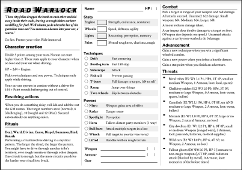
One page game: Road Warlock

A free one-page game created to answer the question "what if the vehicles in a post-apocalyptic road warrior movie were demons that crave speed and violence?"

Partly inspired by Neil Gaiman and Terry Pratchett's book Good Omens, in which the demon Crowley arranges the layout of a motorway overpass to create a bad-vibes-generating satanic glyph when people drive over it.

I may have missed an opportunity by not adding drop bears to the bestiary. Maybe in future editions. Click here to get it.


And since it's an excellent time to be gaming by yourself at home, here's a link to my diceless solo gaming engine.

Saturday, 15 February 2020

One page game: Agents of P.U.N.C.H.

A free one-page game about playing elite government agents who are completely out of their depth.

I've made no secret of my admiration for Tales of Mordhearse, an ultra-light D&D adaptation where the characters have only one stat: HP. The game makes that single stat do a lot of work. It's surprisingly deep and tactical, not to mention perfectly suited for dungeon exploration.

I was thinking about that design philosophy, a single stat game. And I was in a whimsical mood. I wondered "what if the single stat all the characters had in common was punching? And what if that stat was universally set to maximum?"

The result is Agents of P.U.N.C.H. It's not deep. It's not tactical. I'm not sure what kind of game it's suited for, other than (obviously) a very silly one. But it's free! Click here to get it.


Saturday, 5 October 2019

One page game: Wizard Squad

Image by OpenClipart-Vectors from Pixabay
A free one-page game about tactically-trained wizards empowered by the state to investigate incidents of corrupted ancient magic reactivating. Semi-random character creation, 1d20 + mods vs target number. Grab it here.

Wizard Squad is set in a kingdom which is built on the ruins of an advanced civilisation that drove itself into apocalypse through excessive magic-use. Every now and then the seals and wards on some forgotten device breaks down (as often as not through tampering by someone who thinks there's something to be gained by reviving ancient sorcery) and then it's balrogs or worse.

Saturday, 14 September 2019

One page game: Green Card Demons

A free one page game about demons trying to make it in today's economy, integrate socially and also cover it up when they slip and commit horrible crimes.  Semi-random character creation, 2d6+mods vs target number. Get it here.

Thanks to Reddit users Don_Quesote and HeadWright for commentary and layout advice and ThornyJohn for sourcing open license fonts.

I love one page games.  They're perfect for those evenings when your regular GM can't be there or there aren't enough players to make a serious attempt at carrying on the adventure.

Saturday, 10 August 2019

Base building mini-game

I've been playing a lot of Subnautica lately.  It's an open-world exploration game, set 90% underwater.  It has beautifully rendered environments and creatures that really sell it as a completely alien planet.

A big part of the fun is the base building mini-game.  You start basic and level it up as you uncover new blueprints.  My preferred method of gathering resources has become moving to a new area and building a small base with a scanner room that can pinpoint all the useful spawns for me.  When you disassemble a base you get 100% of the materials back, so the only investment is time.

(Meeple Girl has been playing a very different game.  It involves waiting until I'm under threat by a Warper or a Sea Dragon, then walking quietly up behind and tapping me on the shoulder... it ought to be a crime.)

The last couple of weeks I've been thinking about a method for adding a base-building mini-game to OSR games.  Admittedly, some of them already have it, in the form of castles and strongholds from 9th level onwards.  But that's intended to be a significant investment of time and resources for the characters, and a reward for the players who levelled their characters that far, as well as a completely new mode of play.  I'm going for something a lot simpler and self-contained, that the players can get into almost immediately.  This is what I've come up with.  I think it would work best in a system where XP is earned by spending treasure.

It's assumed that the characters will be taking over the available space across several buildings instead of renting a house or workyard.  They'll modify it to suit their needs, as much as practical given the restrictions.  The spaces they have access to are represented by the seven unique Tetris blocks:


Each square in a piece is 10' by 10'.  The first costs 100 GP, or whatever amount is suitable for your system.  Each additional segment doubles the cost.  The characters can keep building until they have everything they need or run out of money.  Each time the players ask for a segment, roll 1d10 and give them the piece indicated.  If the result is higher than 7, repeat the last block.

After the first piece is placed, roll 1d4 for each additional piece to see which cardinal direction from the original piece the next is added to.  The players can rotate the pieces as they like.

The edges at the outside of the pieces (not the individual squares) are assumed to be walls.  The spaces the players put together have no access to each other until they start knocking out walls.  The edges for each piece must be more than half wall to support its weight.  That's five edges for the O piece, six for the others.  Take out any additional walls and the roof falls in.

Example

My budget for rooms is 1,000gp.

First room = 4, the O piece.  100gp.


Second room = 1, the I piece.  The d4 shows a 1, indicating that it's placed at the top of the O piece.  200 gp.

Third room = 4, the O piece again.  The d4 shows a 2, indicating that it's placed at the right of the first O piece.  400gp.


Fourth room = 2, the J piece.  The d4 shows a 3, indicating that it's placed below the original O piece.  800gp, so no more rooms.


If I remove the walls between the two O-pieces, I get a nice big, open space.  Each O-piece can have one additional wall removed, which gives access to the smaller rooms, like this:


Within the limits above, pieces are placed and rotated at the players' discretion.  So if I preferred I could have had a base like this:


And that second layout looks more useful because of the next rule: courtyards.  You can extend the outermost walls in a straight line.  Where they intersect, they enclose a courtyard.  That long, semi-wide layout gives us a couple of decent courtyards for extra space.


For upper levels, start the pricing again from base.  Use the same layout but with each new floor remove 1d2 of the outermost rooms.  There must be at least one staircase on each floor.


What's the point of all this?  The base is mostly intended to be a fun way for characters to spend more gold, and something for the players to feel invested in.  If you're using the XP-for-spending-gold rule, you're probably also using a carousing table.  The rooms you add to your base will give some minor bonuses for mitigating bad rolls on that.  A forge can knock out the dings in armour, an apothecary can shorten the duration of a hangover, etc and you can hire retainers with the skills to use them on a temporary basis.

So next we slot in rooms.

Apothecary - 1 square.  Gives access to a herbalist.  +1 to saves vs disease, allergies, hangovers, etc.

Armoury - 1 square.  Sharpens blades, repairs weapon handles and straps.

Barracks - requires 1 square for each character that sleeps there.  Restricted to one open edge.  Reduces gold lost during a bad carouse by half because you were sensible and left your big purse at home.

Common room - at least 2 squares.  +1 to retainer morale rolls while in town.

Forge - at least 3 squares.  Must be in a courtyard.  At least 1 empty square between it and the nearest building.  Gives access to a smith, who can repair armour.

Kennel - 1 square per 4 dogs.  Must be in a courtyard.  Gives access to a master of hounds, who can provide training and treat sick dogs.

Kitchen - 2 squares.  Rations prepared here will never be tainted or inedible except by deliberate enemy action.  Requires a well.

Library - at least 1 square.  Gives a bonus to research actions and somewhere for magic-users to work.

Shrine - at least 1 square.  A place for rituals.  Gives clerics and paladins a bonus to communing with their gods.

Stable - 1 square per horse.  Each square must have one open edge facing a courtyard or the outside of the building.  Gives access to an ostler, who can replace shoes and treat sick horses.

Staircase - 1 square.  Gives access to other levels of the building.

Training room - at least 3 squares by 2.  Gives access to a trainer if required for levelling or learning new techniques, subject to GM approval.

Trophy room - 1 square per 4 trophies.  The perfect space for displaying souvenirs of past adventures and impressing young wenches or farmboys.

Wash house - 1 square.  removes fleas, tar and feathers, various other forms of soiling.  Requires a well.

Well - 1 square.  Must be in a courtyard.  At least 1 empty square from a forge.

In this case I'm going to have a training room, an apothecary, an armoury, a wash house, a kitchen, a trophy room, a forge, a well, a kennel for 8 dogs and a stable for 4 horses.  My characters can sleep off site.  Opening up all the stable squares to the courtyard means blocking the stables off from the building interior, but that's not a problem.  If you're riding a horse, you're going outside anyway.

Key:
A - stables
B - forge
C - trophy
D - apothecary
E - armoury
F - training
G - kitchen
H - wash house
I - well
J - kennels


And now the part I'm sure my players will spend the most time over: traps.  200 GP each.

Arrow trap

Collapsing ceiling

Fire trap

Gas trap

Glue trap

Magic item trap

Pit trap (if on an upper floor, requires 1 square of unused space on the floor below it)

Poisoned dart trap

Potion trap

Swinging blade trap

There's no reason to restrict player creativity here.  If they want a false wall that releases angry bees, they can have it.  Any 5' square (4 per map square) can be trapped.  The players can set or deactivate a trap as an automatic action, unless you're a particularly hard-nosed GM.  If characters let a retainer get caught in a trap, make a morale roll at a penalty.

Hey, isn't this starting to look kind of like a dungeon?

Yes!  And for your players, this might be an opportunity for introspection that leads to a revelation about their behaviour and real change on a personal level.  Mine are more likely to say "Hey, why not a trap that douses intruders with shrinking potion then drops them into a trebuchet?"

Saturday, 23 March 2019

The Golden Sea AP (part 2)

Link to part 1.

It was late when the skiff approached the Drugtown docks and there weren't many people around.  There was a sign advising visitors not to leave the area without making arrangements with the dock master, so they went looking for him.  They found him in his office, high as balls and dead to the world.  One of the characters had an ability that allowed him to remove stress from another character, and we agreed that it could be used in this case to bring him down from his high and make him responsive.  The character did, and the master woke up, angry at the world because of his dissipated buzz and ready for an argument.

He told them he couldn't give them a permit without sampling their cargo for contraband.  "Contraband?  What's contraband in a town that manufactures drugs?"  "Trouble-maker, huh?  I'll keep an eye on you."  They briefly considered giving him the contaminated chocolate as a sample, but decided against.  He sampled an entire bar, then asked for more samples, to be checked over at a later time.  Instead, they showed him their dead bandit leader.  That changed his tone a little, and he agreed to let them proceed into town.

Sherlock made a roll to figure out where in town they were likely to get the best bounty for a dead bandit.  His roll was at +3 for Mental stat, +2 for an ability and +1 for the hometown advantage.  It was a good result, he remembered the details of the different gangs running the town from his childhood there, including one who particularly hated raiders.  He went by the name Dr Feelgood and his headquarters was up on the hill.

They headed up that way and managed to get in to see Dr Feelgood's secretary, who went by the name Butthead. He was a big guy in leather and a mohawk, so it wasn't immediately obvious what qualified him to be a secretary.  Maybe he was the only one in the gang who didn't eat the pencils.  Butthead told them the doctor wasn't seeing anyone today, and the smartest thing to do was leave the bandit with him and come back for their reward later.  The party immediately pegged that he was trying to cheat them out of the reward.  Yu Tuu tried to intimidate Butthead by opening his coat to show a brace of grenades underneath, but failed the roll.  The room was lined with ratty curtains and they immediately heard the click of a gun being cocked from behind one of them.  Sherlock talked to Butthead like a fellow Drugtown boy to tell him it was all just a stupid joke and the tension eased.  He negotiated a deal by which the party got to see Dr Feelgood immediately and Butthead got 10% of the bounty.

The doctor was brusque with them at first, but once again Sherlock used his hometown advantage to turn the interview into a performance, making him laugh with the story of the first bandit's failed attempt to climb their railing before getting smacked off his bike, and the sideswipe that killed the leader.  Some good rolling increased the bounty by 50%.  The reward turned out to be four bullets suitable for Sherlock's gun, some ancient army field rations (still in original foil packaging) and a set of matched Garfield-print coffee mugs.  They left the body with the doctor and left, paying off Butthead as they went.  He was happy to have something from ancient times to trade at the big market two days from now.

The party went back to the skiff to sleep.  Before turning in, Idonou fired up his ancestral heirloom laptop and created a spreadsheet to figure out profit percentages, putting together a plan to maximise their return at the market.  The crew went to sleep in the cargo hold, leaving Nameless on watch with a pair of night vision binoculars borrowed from Sherlock.  That was a good plan because near the end of his watch he spotted a couple of figures in black sneaking up to the boat.  He yelled for the others, waking them immediately, but also alerting the two skulkers.  They rushed him, pulling knives as they came.  He knocked one off the ramp with his pole, but the other reached him and dealt a minor wound with his knife.  After that, the others were on deck and Sherlock won initiative.  He made a difficult called shot and killed the raider with a single bullet in the forehead.  Nameless jumped down to the sand to threaten the second one with his pole.  That one considered the odds and surrendered, dropping his knife.  They tied him up.

Yu Tuu did a good job of intimidating him by pretending to pull a grenade's pin and dropping it in his lap.  He swore that they weren't working for anyone, a guy in the bar sold them the information that there was a skiff in dock with a valuable cargo and they just meant to steal.  Nothing more complicated than that.  It seemed like the truth, so Valium untied him and told him that since he wanted the chocolate so bad, he could have it.  He brought up the box of contaminated bars and informed the bandit it would cost him all the barter he had.  He went pale but reluctantly agreed to return home and fetch it all.  Yu Tuu and Idonou went with him to keep him honest.

It turned out that 'home' was a grotty flophouse where the town's poorest citizens sleep.  The bandit admitted that he didn't have any barter -- but he'd talk to his friends and they'd be sure to loan him some.  Yu Tuu and Idonou got his mark on an IOU, which meant that if they didn't see him again, they could sell the debt to one of the town's slavers.  They made sure he took the chocolate with him.

They returned to the skiff and all was quiet again until the third shift, when a rumble of approaching hoverbikes woke them all.  It was the three remaining bandits from earlier, coming at them from the desert side.  They didn't bother with stealth, they darted closer and threw molotovs, occupying the crew with putting out the flames.  They drove erratic circles around the skiff, ducking and weaving to make themselves harder targets for Sherlock's pistol.  Nameless smacked one off his bike with a pole.  Yu Tuu tossed a grenade and managed to take out the remaining two in a single explosion.  Idonou chased the downed bandit down to the sand, only to find he was wriggling underneath the skiff.  He called the information up to the deck and Valium took the skiff's controls, cutting the antigrav.  It settled to the ground, squishing the bandit under its prow.

The crew buried all the body parts they could find in shallow graves under the dock and claimed their hoverbikes.  One was in good shape, and the other two were repairable.  The session ended there, but the characters made a good profit off their chocolate and salvage at the Drugtown market and finished their trade run covered in glory.

Saturday, 16 March 2019

The Golden Sea AP (part 1)

Unnamed Golden Sea character
I'm part of a gaming club that uses rooms at a local university.  This is the time of year the university gets an influx of new students, so the club puts aside campaigns for three weeks while the students are on orientation and runs one-shots to let new gamers try out roleplaying.  This week just past I ran a one-off of The Golden Sea.

Golden Sea is a one-page microgame written by Grant Howitt.  Every month he writes a free 1PG and releases them via Patreon.  Grant is the name behind other games like Drunken Bear Fighter, Honey Heist and Pride And Extreme Prejudice.  Most of them lend themselves well to quick, light-hearted sessions.  Golden Sea is one of the more serious examples. (If you want to try it yourself, I really have to recommend J. Wagnaar's redesigned version.  Grant releases games as an angled photo of a collage document.  It's a unique look and I guess it's his signature style, but I personally find them difficult to read.)

Characters get three stats: Physical, Social and Mental.  Numbers are generated by rolling 5D6 and removing both the highest and the lowest.  The remaining numbers get assigned as the player prefers.  There are also eight Paths which each have three Abilities.  Each player selects two Paths for their character and chooses an Ability from each.  It's a very simple system, but the Paths and Abilities make it possible to differentiate characters well.  Task resolution is by rolling 1D20 +stat +any Ability that seems applicable vs a target number.

The setting is post-apocalyptic, but so far past its apocalypse that it's retreated into myth.  My big mistake of the evening was not communicating that aspect of it to the players.  When I described it as post-apocalyptic, they imagined a Mad Max-style chase across the desert.  There were five characters: Idonou, Yu Tuu, Sherlock Holmes, Valium and Nameless.  If you think the names reflect how serious the game was going to be, you would be right.  I went with it, although it would have been nice to explore the implied setting and I might suggest it to my regular group the next time our current GM is out of town.

As well as the Golden Sea rules, I had an oracle app for my phone to give me random ideas, and a copy of Joel Priddy's Knave Fancypants document which includes the Buildings Are People hex exploration rules.

I started the session by informing the players that they were a company of traders,with an antigravity skiff loaded up with chocolate bars from the last working factory in the area and their job was to travel through the characters' home towns swapping the chocolate for barter and returning with a load of water from the only river in the desert.  The players all marked the characters' towns on the map, and the logical choice for first stop was Sherlock's town.  I asked him what the settlement's major resource was:

"Drugs."

Well, okay then.  During the final discussion before starting the players introduced a couple of complications for the characters which I was happy to adopt.  First, they had to keep the chocolate from melting in the desert sun, and secondly they couldn't move diagonally across map squares, only horizontally or vertically.  That meant that drugtown was the only settlement within reach of the company's skiff with the provisions they had.  Valium suggested rationing their supplies to reach a second town (on the map its resource appears to be 'volcano') but the other characters vetoed that idea.

Before starting I consulted my oracle and informed Valium that one of the company owners took him aside on the final night before they were scheduled to leave and told him that one carton of chocolate (subtly marked on one corner) was from a production run that got contaminated in the machinery and it could potentially make people sick.  They still had to sell it, but it was his responsibility to make sure it went to a customer far away from the home town so they'd be less likely to make trouble.  Valium instantly told the other characters, because they were all in it together.  None of them objected to making the sale.  Margins were tight, they needed a profit.

I rolled for weather and got a result of 'worsening from yesterday'.  I ruled that meant clouds and wind, with the potential for a sandstorm to develop if it picked up further.  The characters were cheerful enough, clouds made it that much easier to keep the chocolate solid.  They left early in the morning, had no encounters, and enjoyed an uneventful day.  The weather steadily worsened over the next few days, but the threatened sand storm never arrived, and eventually there was a sudden change back to sunny skies.  That raised the prospect of the chocolate melting, so they rigged a cover out of white sailcloth to keep direct sunlight from hitting it.  That worked and they were able to proceed.

That same day the dice ruled for an encounter and they noticed a column of smoke in the distance.  Sherlock had picked a set of binoculars as his starting equipment.  He checked for the source, but found it was below the horizon.  If they wanted to know what it was, they'd have to turn aside from their route and maybe add an extra day to their trip.  They were on their last day of supplies, so voted to leave it and continue on to drugtown.

They never saw it, but the smoke was from another trading skiff that had been brought down by desert raiders on hoverbikes.  On the map, they were now on a direct line between the crash site and drugtown.  Sherlock had described it as a town run by opposing gangs.  That make it seem like a reasonable destination for the raiders to be headed to trade their plunder for a good time.  I asked the players if they altered their route at all.  No, they decided to stay on the most direct path to drugtown.

The skiff had nice big sails to catch the wind and attention from any observers nearby.  The approaching bandits easily noticed their vessel.  The characters spotted them on the approach and Idonou tried to sharpen a couple of poles into spears.  He rolled badly and failed to put a point on them, but handed them out anyway.  A pole is better than no weapon.  The bandits overtook and separated into two groups of two and three, approaching on opposite sides of the skiff.  Their leader made an obvious 'pull over' gesture.  Instead, Sherlock showed his pistol.  That group of raiders dropped back, and one of the two on the other side threw a burning molotov onto the skiff's deck.  The rag fuse went out before it hit and the petrol failed to burn (a bad roll by the GM).  It made a fairly good distraction though, and the bandit who threw it used the opportunity to try climbing onto the skiff.  The going was difficult (another bad GM roll) and Nameless kicked him off before he managed it.  He went tumbling into the sand.

The riderless hoverbike wobbled away and toppled over, kicking up a fountain of dirt.  The second got closer to throw another molotov, but Nameless fended him away with a pole. (Nameless had 6-5-4 for his stats, and would be the hero on more than one occasion during the evening.)  Sherlock made a difficult called shot and smashed his remaining bottles with a bullet to the saddlebag.

With one bandit dispatched and other disarmed, the party thought the fight was over.  That was when the bandit leader swooped up from his position directly behind the skiff and threw a molotov.  This one splashed burning fuel across the deck.  The characters scrambled to smother it with a tarp, while Yu Tuu swerved the skiff and knocked the leader off his hoverbike.  At the same time, Sherlock shot the other bandit in the head.

Yu Tuu saw two dismounted hoverbikes ahead and discovered that the last two bandits had stopped in order to throw molotovs in tandem as the skiff passed.  He swerved again, but at the speed involved he was only able to get out of one bandit's range as they passed.  A molotov smashed against the skiff's hull and they were on fire again. Yu Tuu brought the skiff low and turned it in a tight circle, scraping the burning fuel off against the sand.  They were scorched but undamaged and turned back to claim the dead bandits' hoverbikes as extra barter for drug town.

Link to part 2.